The protest angel: a Georgian filmmaker’s search for hope under authoritarianism
Voxeurop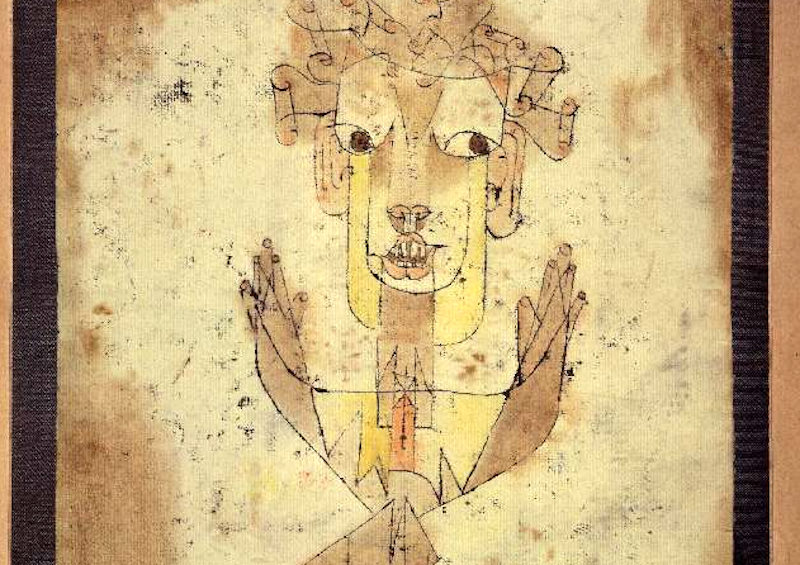
As Georgia’s government silences filmmakers, journalists and activists, Anna Dziapshipa, a director of Georgian and Abkhazian descent, asks what images are still for. She finds an unexpected answer in a 16th-century village church, next to a shop where state TV is never switched off.
The Angelus Novus by Paul Klee, interpreted by Walter Benjamin as the Angel of History, often comes to my mind as a quintessential image of the beginning of the last century. It also serves as a reminder of how much visual language still matters.
Image is the medium I work with and reflect through. I can navigate it best. And yet I recently find myself questioning its power and meaning, even as I believe it remains the strongest way for me to reflect on and rethink the current state of the world. I question it, yet I also rely on and lean on it.
The moment I started to rethink the importance of what I was doing was February 2022, when Russia launched its full-scale invasion of Ukraine. At that point I was editing my film, which was a politically charged autobiography, reflecting on a war I remembered vividly, and which also included Russia as one of its actors. Of course, I already knew that the way we look at things, the way we tell stories, the way we represent people, is never completely separate from the world in which we live.
But the invasion made this connection much more immediate to me. I started asking myself what it means to continue making films when the conditions around us are changing so dramatically. What is the responsibility of a filmmaker in such a moment? And what does it mean to have the possibility of expression, when that possibility is becoming increasingly fragile?
Since then, imagery has carried a different weight. By the end of the painful editing process of my film, I started to question why I should add yet another picture to a world already flooded with visuals in every possible form. I thought about my own practice: the subjects I was choosing, the footage I was producing, and whether I really understood the moment I was living in, its relevance to this particular time and place.
Now, as the authoritarian government in Georgia tries to establish total control over our minds and our movement, tries to marginalise us and turn us into foreign bodies in our own country, tries to silence us, moving images and whatever they carry take on an entirely new meaning again.
I have been very much affected by the efforts of Ukrainian filmmakers who keep making films while living through the war: a filmmaker making a video diary for her kid while also serving as a volunteer soldier; colleagues posting from bomb shelters at night, then taking the long train to pitch their documentaries abroad, trying to be heard over a Russian imperial and far-right propaganda machine that has tried to silence and colonise them for centuries.
I do not want to romanticise this resilience. I do not think that artists should be expected to transform every tragedy into an artwork, or that making films is somehow more important than the other ways people are trying to survive and support one another. But their work has made me rethink the relationship between cultural practice and necessity.
Sometimes we make films because we want to understand something.
Sometimes we make them because we want to share an experience.
And sometimes we feel that if we do not speak out, something will remain unspoken, something will disappear, or somebody else's version of the story will become the only one that survives.
The fog of awkwardness
Now I understand the huge difference between mobilising as a filmmaker during a war, and mobilising as a filmmaker during an authoritarian regime. War, terrible as it is, gives you a strange kind of clarity: a clear front, a clear enemy, a reason to point the camera and know exactly why. Authoritarianism doesn't offer that. It moves through constant disinformation, through lies engineered to sound just truthful enough, through a fog where you're never quite sure whether to react, or what words, what form, could actually cut through it. While war sharpens you, authoritarianism drains you slowly, in a way that's much harder to name, let alone document.
I kept thinking about what angle I could use to speak about authoritarianism in Georgia, because thinking and existing within it has already become our everyday reality, the new normal. The word "awkwardness" keeps coming to my mind, and I feel that there is nothing more awkward than talking about authoritarianism at the very moment of its rise.
From my still limited experience, authoritarianism gathers feelings that don't belong together, and keeps us in a constant sense of guilt: guilt for doing our work, guilt for failing to, guilt for sleeping, eating lunch, reading, like normal people still get to. It is, for everyone and always, a waste of time: for those imprisoned innocently, for those who protest every day, for those who protest sometimes, for those who are unable to locate themselves in this process.
While war sharpens you, authoritarianism drains you slowly
History moves in spirals, not in a straight line. At this point, that spiral has brought us back to experiences the world has already lived through, in various forms of dictatorship, and here, again, I remember the Angel of History: a reminder that not fully understanding the past is exactly why it keeps returning.
But what could resistance look like now? Some of my favourite thinkers often talk about the importance of joy and solidarity, or the deliberate creation of hope, as a new form of resistance. I lean on those thoughts. I think about new forms of solidarity and resistance: perhaps, in such cruel times, it becomes even more important to preserve everyday life, or continue doing whatever we know best, as a kind of shield – not resignation, but resisting the regime from within a preserved psyche, a preserved everydayness. The same favourite thinkers would repeat that "Joy is a new strategy," invoking Nick Cave's words: joy is not a feeling that comes to us easily, sometimes we have to actively search for it. Joy is a decision, an act, even a practice. I would say hope is the same.
In the case of Georgia, the restrictions on civil society, independent media, cultural actors, and public protest have made this space increasingly difficult to occupy. Filmmakers, journalists, and many other cultural workers are being silenced, censored, or even imprisoned.
Growing up in the shadow of empires, my culture always seemed quiet, small, peripheral, the kind of culture empires assume they can erase without anyone much noticing. The war in Ukraine, and what's happening in Georgia right now, are the same imperial reflex, just at different volumes. For me, the experience of being silenced is not new.
I grew up in Georgia in the 1990s, as a member of an ethnic minority, in a nationalist environment. My work grows directly from lived experience as a woman of mixed Georgian and Abkhazian background. My practice is shaped by memory, conflict, and identity, and by the weight of the wars of the early 1990s, which left a deep and unhealed scar on both Georgian and Abkhazian societies. Born into a family split by history, I learned to navigate personal and political space at the same time, and turned to film to foster dialogue where silence had long prevailed.
Today, together with my colleagues, I find myself in an increasingly insecure environment. In late 2024, the Georgian government abruptly halted the country's European integration and introduced a wave of Russian-style laws – against "foreign influence," against foreign grants, against so-called "LGBTQ propaganda." But at the same time, I actively feel how solidarity and community are not just words but a daily practice. I have learned, again, how much we depend on each other, on small circles of trust, on people who show up, listen, share, and help each other through an uncertain times.
Signs pointing nowhere
Over the last couple of years, I've started to escape the city; my partner and I are building a house in a village about four hours away from the capital, a remote place where the challenges of the city don't fade away, but distance makes me rethink them, sometimes lets me forget them, while I lose myself in the transformative process of gardening or building. It changes the perspective, the same way it does with a film; sometimes you need remoteness to understand the present, and to think about how to respond to it, but sometimes you lean in the opposite direction - staying close, filming the present as it happens, almost in real time, as if urgency itself becomes a method.
Though my village might seem like a shelter, my guilt and my conscience won't let me fully escape. The visual collapse of the country: abandoned houses, demolished infrastructure, collapsing bridges, decaying buildings - all the remains left by greed and power, still speak to us. The pain is inescapable, loud, and devastating. It feels like the howl of a country on the edge of disappearance.
Even though I'm far away from the city, far from billboards and saturated imagery, I still see signs everywhere around the village. On the one hand, it seems they represent nothing but nothing, but on the other hand, not only do they embody disappearance, but, strangely enough, they still show the direction to move in, somehow voicing my confusion, my guilt, and at the same time obliging me to move. They don't have a clear destination. They don't tell me where to go, or what the correct direction is, or what shape my response should take. But they indicate movement, and that became important to me.
I do not have a complete answer to the question of resistance. I do not know whether my response will be a film, a public gesture, a collaboration, or something I cannot yet imagine. But perhaps not knowing the destination doesn't mean I should stay still. Perhaps these signs matter precisely because they refuse to give me a final answer. They just ask me to remain attentive to the moment, to look for the openings, the cracks, the moments when something that seemed impossible becomes possible.
Apparently those dysfunctional signs still work, as they led me to the spark of my hopeless summer: an encounter with the angel.
The greengrocer and the angel
On my usual detour, I revisited a 16th-century local church, surrounded by lush greenery and a decaying, beautiful family cemetery. The keys to the church were kept in a small grocery shop. When I stepped inside to ask for them, the propaganda TV was on; it made me think of Václav Havel's greengrocer, who puts a sign among the onions and carrots reading "Workers of the world, unite!", not because he believes it, at the end of the regime, but because that keeps the shop running and nobody asking questions.
I think about the man who holds the church key. His shop has a television going all day, tuned to state propaganda, loud enough to fill the whole room and maybe the quiet village street outside, loud enough to brainwash. I have started to wonder if the smallest, least dramatic form of resistance any of us has left is exactly that: reaching over and turning the television off.
I've been in this church a few times before. I love its details, Saint George's horse with sad eyes, hand gestures of the saints, or the local feudal family painted along one wall, in their 16th-century robes, whose appearance looks, strangely, exactly like the grocery shop owner next door.
But I had never noticed the importance of the Seraphim, the angel of the first rank, holding a sign identifying the saint depicted beside him. It was something so familiar and known that it took a while to transform, for me, into an unexpectedly contemporary picture. A figure from another historical time, carrying a sign that seemed to speak to the present. Some kind of protest, or resistance angel.
Not an angel that comes to rescue, not an angel that promises that the future will be bright. But an angel that seems to be pointing toward something, even if we do not yet know exactly what this something is.
Klee's angel, as Benjamin sees it, is looking at the wreckage. My protest angel is carrying signs. One is confronted with what has already happened, with a destruction that cannot simply be undone. The other seems to indicate a direction, a possibility of movement.
I do not think that one cancels the other. For me, they can coexist, as I also feel that we are living through a moment in which it is very difficult not to look at the wreckage.
The connection is not that one angel is pessimistic and the other optimistic. It is that they can hold two positions together: the difficulty of escaping history, and the necessity of trying to intervene in it, exactly the same as documenting the present, or reflecting on the past through filmmaking or any other art form. Maybe that's the only kind of hope available to me right now: not an answer, but the indication that tells me to keep moving anyway.
When I left the church that afternoon and walked back to return the key, the television was still on. I found myself wondering whether the greengrocer would ever put a different sign in that window and, one day, walk into the church to also encounter the resistance angel like me.
This is a transcription of the speech Anna Dziapshipa gave at the Georgian Cinema Now event, organised at Berkeley Art Museum and Pacific Film Archive (BAMPFA) in late September 2026.