We promised ourselves democracy, not capitalism.
Kapitál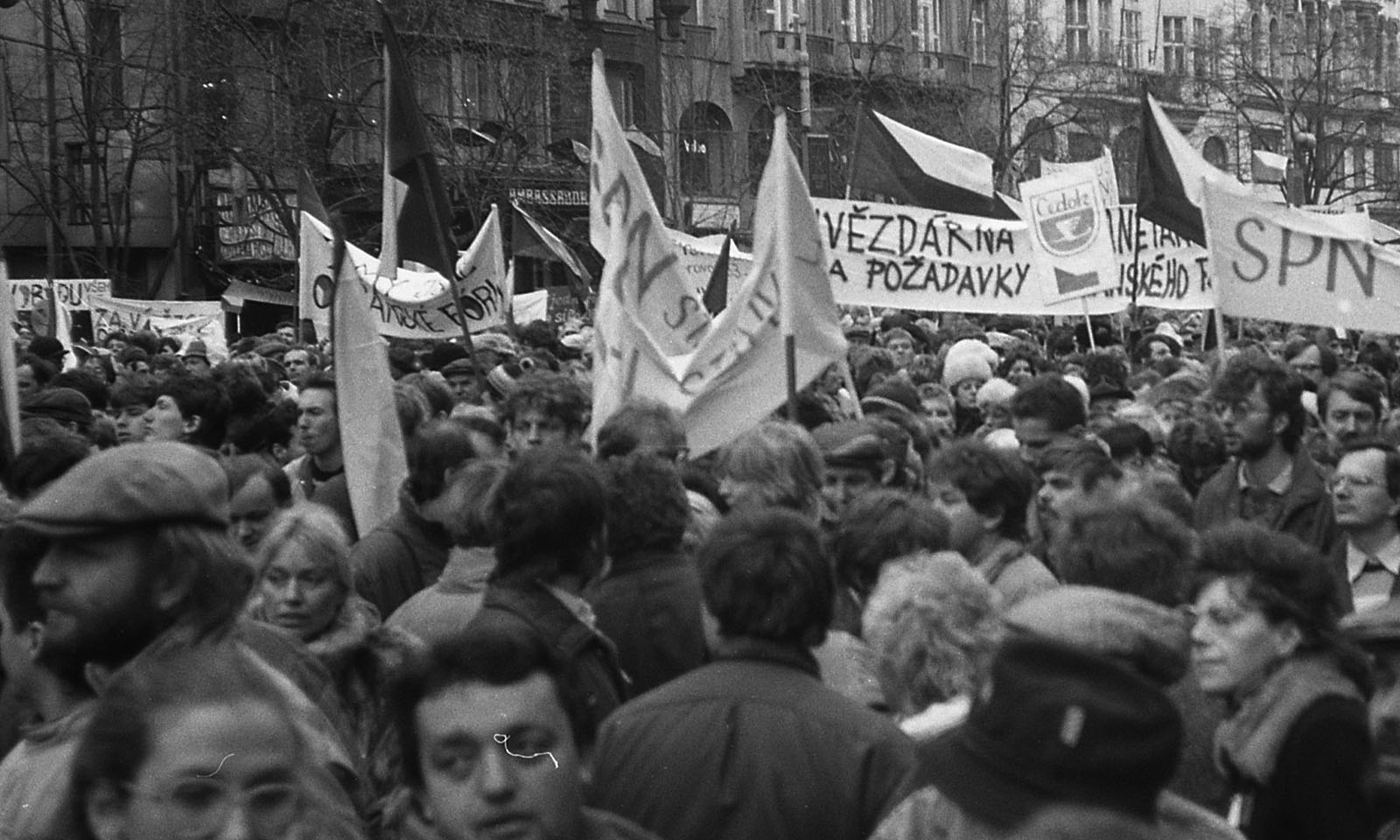
Who does November 17 belong to? The article challenges its continued portrayal as a victory of the right over the left and recalls the social and emancipatory demands that accompanied the fall of totalitarianism. What happens when those in power appropriate the historical mythology of freedom?
Every year, the question arises whether and how the left should celebrate 17 November. The classic response is to emphasize the non-partisanship of November and the fact that the masses in the streets demanded freedom, not capitalism. But it is possible to go further: 17 November does not belong also to the left – it belongs above all to the left.
The communist regime disfigured the socialist idea, whose essence is human freedom. In 1989, the totalitarian regime was not brought down by an opposition from the right, but by the resistance of the entire society – including the majority of the population, which did not reject the socialist project, but rather the lack of freedom and normalization. The critical mass did not demand privatization, but social justice and dignity. The totalitarian regime was thus defeated as if from within the socialist idea.
It was a fleeting victory, but nevertheless worthy of respect – today, however, it has been grotesquely distorted.
The medieval carnival was a ritual reversal of the social order. Kings and priests were symbolically deposed, and the people crowned fools in their place. For a brief moment, moral and religious restraints fell away, the people let loose, and in the morning came a return to the old order. Today, too, we are witnessing a certain carnival. Those who spend the rest of the year constructing a narrative of Slovakia as an unfree madhouse take to the platforms to celebrate the regime that has ruled here for 37 years. Conversely, those who have governed under this regime for most of the time either withdraw from the public sphere to Tel Aviv, or smear the Velvet Revolution outright.
On November 18, liberal democrats will climb down from the platforms and remember that much is rotting in this Slovak state. Conversely, the social democrats who cannot bring themselves to call the state-forming revolution by its name will return to praising the state that revolution created.
On the margins of the carnival, the commentariat burns the effigy of communism. It is said that on 17 November a critical mass took to the streets and drove socialist evil onto the rubbish heap of history by jingling keys. The superpolitical significance of November as a victory of freedom over unfreedom is increasingly twisted year after year into a victory of the right over the left.
November Does Not Belong to Neoliberals
In November 1989, workers at the Bratislava shipyards spoke of a “new, socially just society.” “The most beautiful world can be ours!” wrote the students. They wanted less ideology and political pluralism, but demands for social justice, an end to political violence, and respect for workers’ rights also dominated. In the end, the communists also embraced this language.
According to surveys from 1989, 45 percent of the citizens of Czechoslovakia wanted a “socialist path,” 47 percent wanted “something between socialism and capitalism,” and three percent favored capitalism.
The uprising was directed primarily against the communist party and the “red aristocracy,” not against the “socialist idea.” Claiming that at that moment there was a division into “us” and “them,” as some do, is therefore at the very least misleading. Even if so, “they” were not socialists, but apparatchiks.
The Velvet Revolution is not unique in its nonviolence; that can be explained by the international situation and the zeitgeist, in which suppressing resistance by force would have been madness. The Velvet Revolution is unique in that totalitarianism fell here as if from within the socialist idea, before socialism itself fell.
Socialism and totalitarianism were in tension from the beginning, a tension stemming from the contradiction between an ideology proclaiming the liberation of humanity and a regime that trampled on human freedom. The greatest threat to socialism, both in the Soviet Union and in Czechoslovakia, was never an opposition from the right, but opposition from leftists who understood that the regime was betraying its own ideals: the democratic and national socialist Milada Horáková or the representatives of the Prague Spring.
Ultimately, November 1989 did not manifest itself as the awakening of some rustic right-wing mass, but as a rejection of the totalitarian impulse without an inevitable rejection of socialism.
Nearly four decades of privatized discourse have distorted November into a clash between a critical right-wing mass and communist warlocks. Not history, but an absurd farce about good and evil, in which omnipotent evil can be defeated by jingling keys, rests in the cloakroom of the moral imagination of political opportunists.
The Grammar of Power
In July 1990, literary critic Milan Hamada wrote a devastating reflection on the socialist regime: “Power controlled by this idea very quickly decided to act according to its own logic and to give up the idea rather than its own power. [...] Power identified itself with its own essence, and the idea was left powerless.”
November was an uprising against a regime of idea and power that over the decades had rotted into a regime of power for power’s sake. Rejecting the essence of this regime required rejecting the ugly reality of power as such. That did not happen.
Slovak society is obsessed with power; at every level of social life, the coarse language of dominance and violence proliferates. Nearly four decades after the fall of the regime of power, we still speak of politics as power, as if this language belonged more properly to mythical Oriental despotisms. Unable to rid ourselves of the real pathology, the grammar of power, we celebrate at least the empty freedom of thought.
Content with the formal freedom of thought, we forget that material social structures exist that determine what is and is not thinkable. A society whose media are largely under the control of an oligarchy and ideological cliques is free at most on paper. Its paper freedom is worthless.
It is therefore no wonder that fascism is on the rise. The media oligarchy opportunistically amplifies extremism: partly for attention, and partly because its fascists are useful to it. This is a global phenomenon. The Slovak addition is the coarseness of speech and thought, which is a natural companion to fascism.
Freedom and unfreedom do not belong exclusively to any one regime: the conditions for both arise differently in different regimes. However unfree socialism was, it was possible to defeat unfreedom from within it – tragically late, to be sure. By contrast, the current regime is flirting with unfreedom more and more. Technocapitalists understood long ago that capitalism and democracy are now opposites. Many democrats refuse to understand this.
If anyone has a sincere interest in saving the post-November regime, the first step is to recognize the broader significance of November, and thus of Slovak democracy; to incorporate and absorb the left into the mythology of November, where it ultimately has its own historical place. Childish ideologizing about unfree socialism and capitalist utopia has the opposite destination: the falsification of 17 November and the condemnation of the democratic republic.

The text was produced with the support of the Rosa Luxemburg Stiftung foundation, represented in the Czech Republic. The publisher is fully responsible for the content; the views presented in the text do not necessarily represent the foundation’s position.