The dispute over Poland’s Constitutional Court has escalated. But it didn’t have to come to this.
Kapitál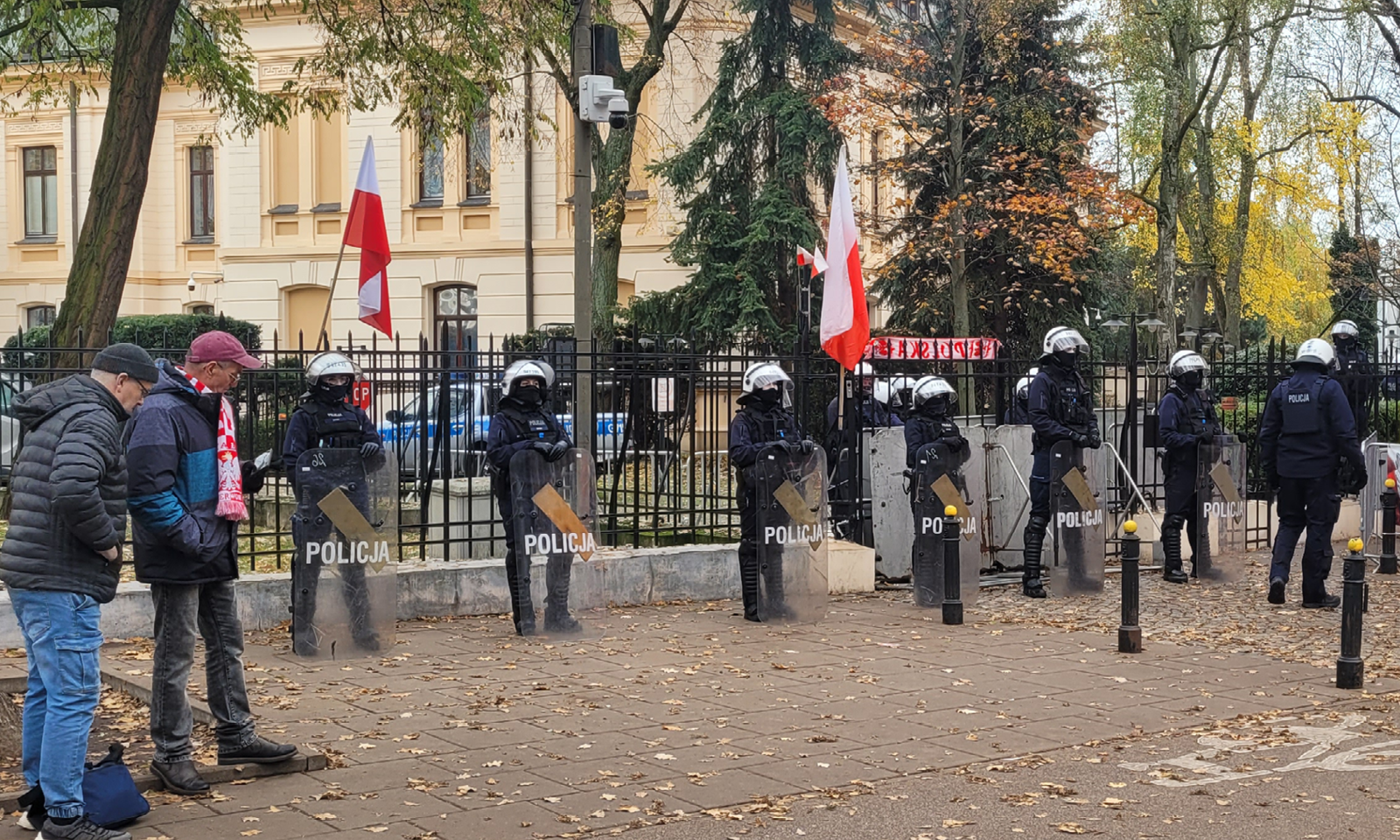
On Friday, October 30, a group of eight judges elected by the ruling coalition took over the Constitutional Court by force. Prime Minister Tusk apparently concluded that after three years of efforts to find an amicable solution, it was necessary to take a tougher line. Friday’s events are merely a continuation of the crisis that has been ongoing since 2015.
On Friday, October 30, an eight-member group of judges elected by the ruling coalition forcibly took over the Constitutional Court. Prime Minister Tusk apparently concluded that after three years of efforts to find an amicable solution, it was time to take a tougher approach. Friday’s events are merely a continuation of the crisis that has been ongoing since 2015.
On the eve of All Souls’ Day, a large number of police officers appeared around the Constitutional Court in Warsaw. The ruling coalition decided to bring it under its control. It chose a convenient date for this. The president was heading on a state visit to Senegal, and people had set out for cemeteries to remember their deceased loved ones.
Accompanied by members of the State Protection Service (SOP, Służba Ochrony Państwa), a body subordinate to the Ministry of the Interior, eight government-appointed judges entered the Constitutional Court building and took control of the premises. Judge Anna Korwin-Piotrowska subsequently announced that she was suspending the activities of Constitutional Court President Bogdan Święczkowski and his deputy Bartłomiej Sochański for 30 days.
When President Karol Nawrocki learned what was happening in Warsaw, he ordered the return while still in the air. President Święczkowski and the opposition immediately described the situation around the Constitutional Court as a coup. It should be added that opposition politicians regularly resort to this rhetoric when they dislike something. In Poland, terms such as coup d’état or coup are therefore gradually losing their weight and becoming empty. This may have undesirable consequences, as a label intended to mobilize society at crucial moments will no longer be taken seriously by anyone in the future.
But let us return to Nawrocki. After landing, the president, together with his security detail, entered the court building, where he physically clashed with Judge Piotrowska. He told her to clear the way for him and then forced his way past her. At least that is how Constitutional Court Judge Maciej Berek, who is close to Prime Minister Tusk, describes the tense moment. Marcin Przydacz, from the president’s office, on the other hand, claims that Judge Piotrowska and her colleague Krystian Markiewicz violated the inviolability of the president.
Nawrocki then also shouted at Judge Piotrowska and the others present: “You are not Constitutional Court judges!” Leaving aside the fact that it is not the president’s role to raise his voice, the head of state has no authority to determine who is or is not a judge. In Poland, that authority belongs to the Sejm.
In addition to Nawrocki, the opposition’s political leaders also used the dramatic circumstances to draw attention to themselves. Outside the Constitutional Court complex, alongside demonstrators protesting the destruction of the court’s existing form, appeared the chairman of the Law and Justice party, Jarosław Kaczyński, together with another politician from his camp and former defense minister Antoni Macierewicz. They warned of a government without the rule of law, a state of emergency, or a new ZOMO. This is an acronym referring to the repressive force of socialist Poland known as the Motorized Reserves of the Citizens’ Militia (Zmotoryzowane Odwody Milicji Obywatelskiej).
Jarosław Kaczyński told those gathered that Poland was becoming a police state, from which, in his view, there was a direct path to authoritarianism and then totalitarianism. The surveillance of inconvenient people and political competitors using the Pegasus spying system, which took place precisely during his tenure, was apparently an expression of freedom.
The renegade Law and Justice politician Mateusz Morawiecki was also present. Until recently, Kaczyński could not stand him because of his departure from the party, yet this time he invited him to join him without any problem. Sławomir Mentzen and Krzysztof Bosak of the far-right and anti-Ukrainian Confederation, as well as the pro-Russian and antisemitic politician Grzegorz Braun of the Confederation of the Polish Crown, also came to support the unity of the right-wing fascist camp—for there is no other way to describe the grouping that may well rule Poland in the next parliamentary term. Kaczyński subsequently took a selfie with Braun. Once again, as when he formed coalitions for Senate elections, he demonstrated that he is close to a man who claims to love the smell of Russian gas in the morning and will not hesitate to ally himself with him.
As for the president’s performance, acting Justice Minister Waldemar Żurek described it as shameful and expressed hope that Nawrocki’s behavior would be investigated. The truth, however, is that given the current balance of power in the Sejm, Karol Nawrocki is virtually immune from punishment. The chances that he will have to answer for his behavior before the State Tribunal (Trybunał Stanu) are very slim.
Destruction lasting two electoral terms
In 2015, the Law and Justice party elected its candidates to the Constitutional Court for five judicial positions that had already been filled. Through gradual legislative changes, it then managed to bring this branch of the judiciary under its control. In 2023, Kaczyński’s right-wing United Right coalition had to leave the field, as the then opposition, led by the Civic Coalition, won the election. Upon taking office, it refused to recognize the legitimacy of the Constitutional Court and simply ignored its decisions and rulings. At the same time, it promised to restore the rule of law in Poland. Adam Bodnar, the first justice minister in Tusk’s government and a former ombudsman, attempted to find an amicable solution to the ongoing constitutional crisis. His 2024 proposal consisted of requiring every judge to have a nonpartisan recommendation and electing judges by a qualified majority, meaning that a three-fifths majority of Sejm members would be required. The Polish parliament has 460 deputies, so 276 of them would have had to vote in favor. In the end, the government and the opposition would therefore have had to agree on the candidates. However, the law, which had the potential to de-escalate the situation, did not pass through the then-serving president, Andrzej Duda, who referred it to the Constitutional Court for review. The court declared it unconstitutional.
Everything therefore ended in a stalemate. The government continued to disregard the Constitutional Court. It even refused to appoint replacement judges for those whose terms had expired. This changed only in March this year, when the coalition began filling the vacant positions. The Sejm, which has authority over this matter, gradually elected eight new judges. In this rejuvenated composition, nominees of the ruling coalition should now have a majority.
The crisis was not resolved, however, because President Karol Nawrocki refused to accept the oath from five judges, which newly elected judges are supposed to take in his presence. He cited the manner of their appointment as the reason and also questioned their qualifications. The judges ultimately took their oaths only before parliament and sent their written oaths to the head of state at the presidential office.
According to the Venice Commission, however, judges do not need to take their oaths in the president’s presence if he himself obstructs them from doing so.
The Polish Constitution states that judges are selected by the Sejm. The president himself plays no role in the nomination process. If the president therefore suggests that he does not consider someone to be a judge, he is violating the Constitution.
Another obstacle proved to be the current president of the Constitutional Court, Święczkowski, who refused to let his new colleagues into the building and even physically prevented them from entering.
He even ignored an order from the European Court of Human Rights. The court ruled that the judges had the right to begin working. The president of the Constitutional Court, however, argued that this institution had no right to demand anything of the kind.
There is currently a dual power structure at the Constitutional Court. Among the newcomers, its president is considered to be Piotrowska, the longest-serving judge, who took over its leadership after suspending the activities of her predecessor and his deputy; at the same time, its former and now removed president Święczkowski still considers himself to be in charge. He has no intention of accepting the judge’s actions.
Regardless of which of the two remains in charge, the problem is that each is recognized only by their supporters, which undermines the credibility of the Constitutional Court.
Karol Nawrocki did convene a meeting for Saturday, which, in his view, was intended to calm the situation, but the truth is that it was pointless, because if he had genuinely wanted reconciliation, he would have accepted the judges’ oaths.
The opposition wants the government to negotiate with it
Today’s opposition, which is largely responsible for the deplorable state of the rule of law in Poland, is calling for a so-called reset of the system, which in its most trivial form means reaching a joint agreement on the judges. It is as if the previous government did not realize that it was the one that systematically destroyed public institutions for a full eight years. We can currently observe some of the leading actors of that period attempting to evade responsibility. One of them is former Prime Minister Mateusz Morawiecki, who pretends he was not involved in anything. Moreover, Kaczyński and the entire opposition, which now ostensibly wants to negotiate and make compromises, have already been offered a hand in reconciliation—let us remember. President Nawrocki, however, completely buried the initiative through his uncompromising approach.
Although the government is now reaping criticism as well as support for its actions, mainly because of its use of the police and its reduction of the Constitutional Court’s quorum for decision-making from eleven to eight, which occurred precisely through the takeover of power by the group of judges elected this year, it appears that it had no other option. Elections to the Sejm await Poland next year, and the government had to show its voters that it was serious about restoring the rule of law. Moreover, the Constitutional Court has not functioned for many years, and nothing can be done about this through legislative steps without the cooperation of the opposition and the president. Poland, however, faces the question of whether, when correcting the judiciary, it is permissible to resort to methods as controversial as those used by the previous government, even if the intentions are pure. The quorum precedent also places responsibility on the current political leadership for its possible abuse by those who come after it. Who will decide that next time it will be enough for only five out of the court’s fifteen members to form a quorum?
Donald Tusk apparently wanted this act to show that his coalition was also capable of taking action just as treacherously and harshly as the United Right under the leadership of Law and Justice. Whether he convinced Polish society that his decision was correct remains to be seen. It is already clear, however, that until Poland’s political culture changes, only bad and even worse solutions are on offer as a way out of the constitutional crisis.
No law is strong enough to confront human callousness on its own. If there is no will to abide by its letter, it becomes a scrap of paper.


This text is part of the PERSPECTIVES project—a new brand for independent, constructive, and multiperspective journalism. The project is funded by the European Union. The views and opinions expressed are those of the author(s) and do not necessarily reflect the views and positions of the European Union or the European Education and Culture Executive Agency (EACEA). Neither the European Union nor EACEA accepts any responsibility for them.