Mourning as defiance
Kapitál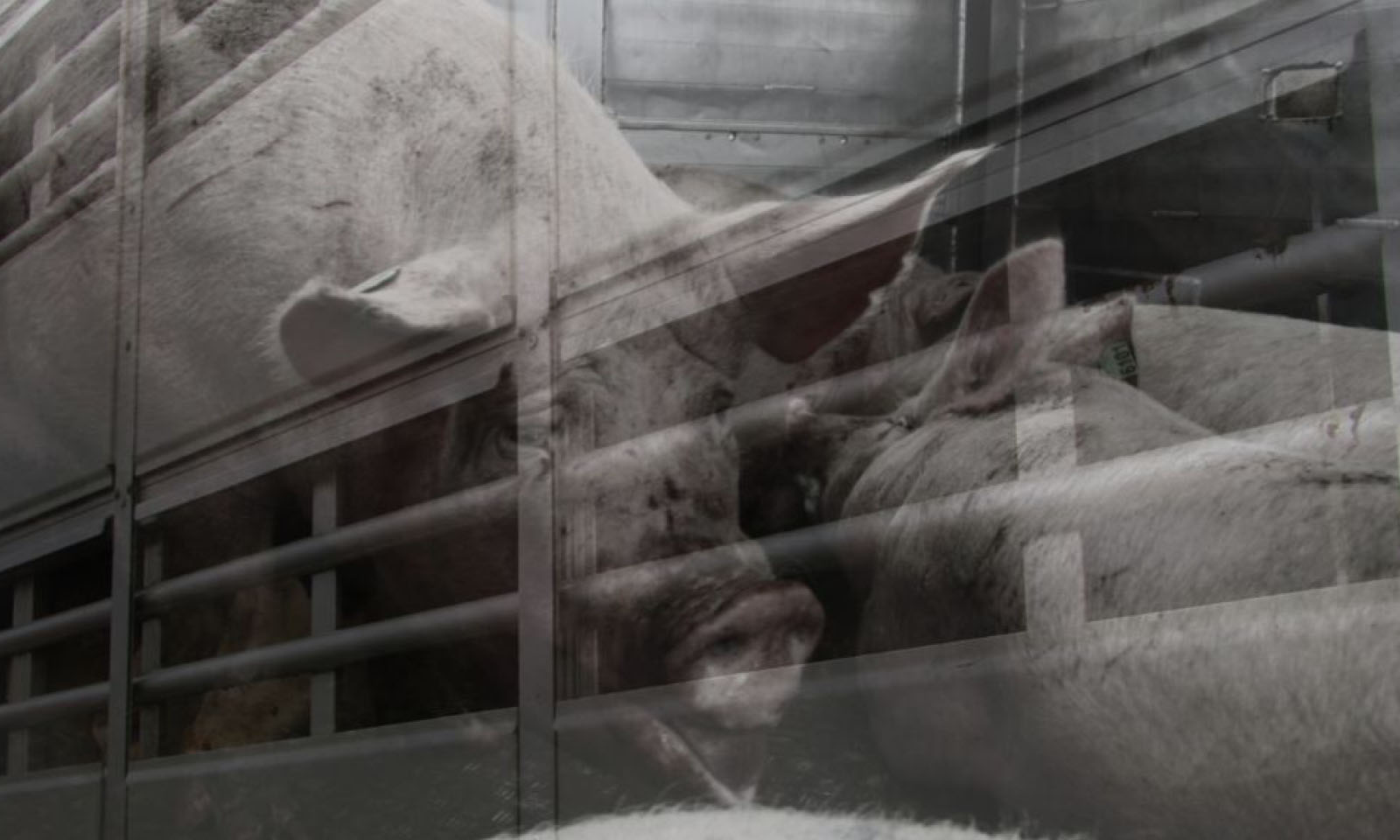
Which beings are worthy of living alongside us, and which have we reduced to mere sources of food? Why do some become pets while others become dinner? How can we mourn those whose lives are rendered invisible for the sake of the smooth operation of the animal industry? In a system that separates us from other beings, mourning “livestock” represents a rejection of the logic of capital, which transforms diverse interspecies relationships into a single value—profit. Activists therefore gathered in Kostelec u Jihlavy to say farewell to “livestock” animals headed for slaughter and to bear witness to the fact that they ever existed at all.
Which beings are worthy of living alongside us, and which have we reduced to mere sources of sustenance? Why do some become pets and others dinner? How should we mourn those whose lives are rendered invisible for the sake of the smooth functioning of the animal industry? In a system that separates us from other beings, mourning “farm” animals represents a rejection of the logic of capital, which transforms diverse interspecies relationships into a single value – profit. Activists therefore met in Kostelec u Jihlavy to say goodbye to “farm” animals heading towards death and bear witness to the fact that they ever existed.
It is the beginning of autumn when I arrive by a morning train in Kostelec near Jihlava. Before I get off, I catch sight of the lights of police cars through the window. The train stops not far from the slaughterhouse belonging to the company Kostelecké uzeniny, which boasts on its website of more than a century-long tradition with Czech roots. This is where a group of activists from the Animal Save Česko movement is heading to say goodbye to the animals brought to the meat-processing plant to be killed.
The action has two aims. First and foremost, it is a farewell to the animals – human attention and sensitivity are meant to calm them in the final moments of their lives. The activists also use the time while the transports are stopped to take photographs and record videos, so that they can convey the reality of the animal industry to the public. “When people die, funerals are held and we mourn them. Yet no one thinks about the fact that millions of beings are murdered all over the world every day. Animals also deserve someone to honour their memory,” the event’s organiser Anita explains to me.
The commemorative actions, known as vigils, represent a particular form of activism. Their aim is not to disrupt the operation of the slaughterhouse, but to spend the final moments together with animals that have been regarded as property or a resource throughout their lives.
The story of the vigils began almost sixteen years ago in Toronto, Canada. At the time, Anita went for a walk with Mr. Bean, a canine being she had adopted. On the way, they encountered a truck full of other beings – classified as “farm” animals. While Mr. Bean could run freely beside his human companion, the pigs in the truck could barely move. The overcrowded vehicle was taking them to a slaughterhouse, where they were soon to be killed.
It was precisely the encounter between these two realities that led Anita to organise vigils. Vigils for beings divided on the basis of a classification and hierarchisation of species that determines which beings are worthy of living alongside us and which we kill in the sterile spaces of slaughterhouses. Another consequence of such hierarchisation is which beings we consider it normal to mourn and whose existence and dying we overlook. We usually come into contact with these animals only when their remains have been packed in neat packages stacked on shop counters. Anita therefore began bringing together people with whom she stood outside slaughterhouses, stopped incoming transports and said goodbye to the animals. What began as a local initiative gradually became the extensive international organisation Animal Save Movement, which strives to liberate animals.
Who is (not) mourned?
The death and mourning of animals remain overlooked topics in Western society. In the intellectual tradition that refers to ancient Greek roots, humans were considered the only beings aware of their own mortality. According to Martin Heidegger, in this sense human beings are defined by an awareness of their own finitude, which awakens deep existential questions in us and distinguishes us from animals. Animals, by contrast, are supposed to be trapped in their instincts and merely “come to a natural end”. We construct instinctive, irrational animals as forms of being entirely separate from conscious humans, differing also in the ways they die and are mourned.
To this day, conservative circles voice the opinion that animals do not die, but merely “perish, expire, croak”. Thom van Dooren, a philosopher studying interspecies mourning, points out in this context how the capacity to mourn, attributed exclusively to humans, has been and continues to be used to justify supposed human superiority over other species. It is another boundary intended to separate “us” from “the others”.
Humans, however, are not the only beings that experience a complex inner life, nor the only beings that mourn those close to them. Remembering what we share in our experiences is important: it undermines the notion that separates humans from animals and helps us better understand our own feelings when we lose beings close to us.
Those of us who have experienced the death of beloved animals – pets – can testify to how difficult the feelings accompanying mourning for them are. Coming to terms with the loss of a close being with whom we have built a relationship over many years knows no boundaries between animal species. While many of us feel the loss of the beings we live with, the situation of “farm” animals is different. Most of us never come into contact with them during their lives. They live and die behind the sterile walls of intensive farms and slaughterhouses, hidden from public view. Even if they experience human “touch”, it is not contact of a kinship-like nature that would allow interspecies reciprocity to emerge, but violent contact that leads to their killing. We therefore do not perceive “farm” animals as beings with whom we can live, but as sources from which commodities can be produced. The demands of capital distance them from most of society, and their dying goes unnoticed.
The commemorative actions organised by the Animal Save Movement seek to resist this logic. By mourning overlooked animals, they reject the logic of capital that reduces their diverse lives to resources intended for consumption. They remind the public that the life of every individual animal matters, regardless of what benefit it brings to people.
The worst thing is helplessness
As we stand by the Kostelecké uzeniny facility, trucks transporting frightened animals crammed into confined spaces gradually arrive at its entrance gate. We approach the transports and document the condition of the animals. We see bloody injuries on the bodies of many of them; some even have deep wounds from electric cattle prods. A heavy smell of excrement spreads through the air. It is interesting to observe that despite everything, some animals are not afraid of us and are curious. When we slowly approach them, they stick their heads through the openings in the trucks’ structure so that they can sniff us.
“Everyone says goodbye in a different way. Some people simply stand quietly and take in the animals, while others try to stroke them,” one of the activists describes the process of mourning. Many of those present speak to the animals. “I try to send them warmth from a distance. To send them the thought that they are safe. I believe they can feel it, because every living creature responds to you, to your frequency. When a person is calm, the animal is calm too. Just as with dogs and cats,” one participant observes. Another adds that she tries to give them “a loving touch when they have never known love”.
I approach a cow sticking her muzzle between the bars. We look into each other’s eyes. My eyes fill with tears, but I try to hold them back. We are here for the animals. I step closer and extend my hand towards her. She begins to sniff it curiously and after a while licks it. I look at the tag in her ear. I discover that she is only two years old. Under different circumstances, she could live to be twenty. I stroke her muzzle and speak kind words to her, sensing her breath slowly calming down. Suddenly a signal sounds; we have to step back, the transport is moving. I continue looking into her terrified eyes as she moves away towards the place where she will soon be killed. I remain standing with a feeling of complete helplessness.
One of the activists later confides in me about her first experience at the commemorative actions. “When I went to a vigil for the first time, I vomited. Since then I never eat before actions; my body remembers it. It doesn’t matter what a person sees, it is always about death. My first experience was so horrible that it left its mark on me.”
Another participant speaks about how her experience changes with repeated participation in vigils. “Here, a person is attuned to a different energy; they are here for the animals. The worst part is when I come home afterwards and look through the photos and recordings. It comes gradually. When a person wakes up the next day, sobbing and unable to stop.”
The others nod and add their own experiences. “The worst thing is helplessness. We try to do everything we can to make it stop, but then a person stands here and cannot help the animals in any way. They look into their eyes while their transport carries them onwards to their deaths.”
The banality of thoughtlessness
The last truck approaches the slaughterhouse, this time full of pigs. After a while, a police officer approaches us with an amused expression on his face. He stands beside us, spreads his legs, tucks his hands into his vest and explains to us with an important look how things really are with animals in the animal industry. According to him, consuming animals is their natural fate and the only sustainable form of human nutrition. He does not respond to the arguments of the activist, a trained nurse.
The police officer is not trying to defend the suffering of animals as such. He concedes that we should not cause them unnecessary suffering. The genetic modification of the bodies of “farm” animals, the forced insemination of females and their separation from their young, who are either murdered straight away or locked in cramped spaces where they survive their entire lives only to be cold-bloodedly killed – all of this is nevertheless, according to him, a natural order that should not be interfered with. He does not speak like someone who would approve of animal abuse in another context. It is not a consistent position, but an anxious effort to defend the established state of affairs.
Hannah Arendt described the defence of war crimes committed by the Nazi official Adolf Eichmann with the concept of the banality of evil. She aptly expressed through it the nature of instrumental thinking as the extreme consequence of Enlightenment modernity. Such thinking is characterised by the thoughtless observance of regulations without perceiving the connections between one’s own actions and their consequences for others. It is an absence of empathy.
“Arendt did not see in Eichmann an incomprehensible monster, but something much more terrifying – she saw ordinary thoughtlessness,” explains philosopher and biologist Donna Haraway. Eichmann committed extreme crimes that were not driven by any motives, only by the thoughtless observance of regulations. Haraway develops this argument further in relation to other species as well. In the book Staying with the Trouble, she writes that “Eichmann was not indifferent to function, he was not indifferent to duty, but he was indifferent to the world”. It is precisely our disconnection from other human and non-human beings that leads to catastrophes.
The concept of ordinary thoughtlessness helps us understand the clash between the perspectives of the mourning activists and the view of the police officer rationalising the suffering of the animals he was witnessing. It aptly captures the nature of the widespread justification of the apparent necessity of the animal industry. In such defences, animals do not appear as individual beings with their own experiences and interests, with whom we can empathise; they are reduced to the quantification of nutritional values or monetary profit.
In the book Modernity and the Holocaust, Zygmunt Bauman writes that “we feel mainly with our eyes” – if one being is to become alienated from another, it must be removed from our field of vision. It is no coincidence that since its emergence, the animal industry has introduced ever new ways of distancing animals from people’s sight. This happens by enclosing animals behind the walls of intensive farms and organising the work process so that as few slaughterhouse workers as possible come into contact with the animals. Timothy Pachirat also noticed this during his undercover work in a slaughterhouse. It must therefore be emphasised that this is not the fault of individuals, but of a system that functions precisely on the principle of rendering animals invisible and alienating them from most of us. It is up to us, however, to resist the order that leads us to “ordinary thoughtlessness” and to learn attentiveness and responsibility towards our kindred beings.
Let us learn to mourn together
Van Dooren believes that mourning is part of developing responsibility towards the beings with whom we share the world. If, amid today’s accumulating crises, we want to learn to inhabit the planet more sustainably, people must, according to him, abandon the notion of their species’ exceptionalism and learn to mourn together with other beings. The activists who go to slaughterhouses and mourn animals for hours teach us to restore relationships with those who are forgotten – even though the killing of animals is considered normal in society and mourning them is seen as a sign of oversensitivity.
“I am here to say goodbye to the animals that people are taking to the slaughterhouse. We can no longer help them, but we can at least be the only people who loved them during their lives. We can record footage during the final hours of their lives and bear witness to the fact that they ever existed,” one of the activists explains the reason for her participation.
Mourning is a way of showing that the animals violently deprived of life and dignity mattered. It is a political act of resistance against the erasure of individual animals in the face of a system that seeks to render them invisible and reduce them to mere sources of profit.

The text was produced with the support of the Rosa Luxemburg Stiftung foundation, represented in the Czech Republic. The publisher is fully responsible for the content; the views presented in the text do not necessarily represent the foundation’s position.