This conflict is not generational, but class-based.
Kapitál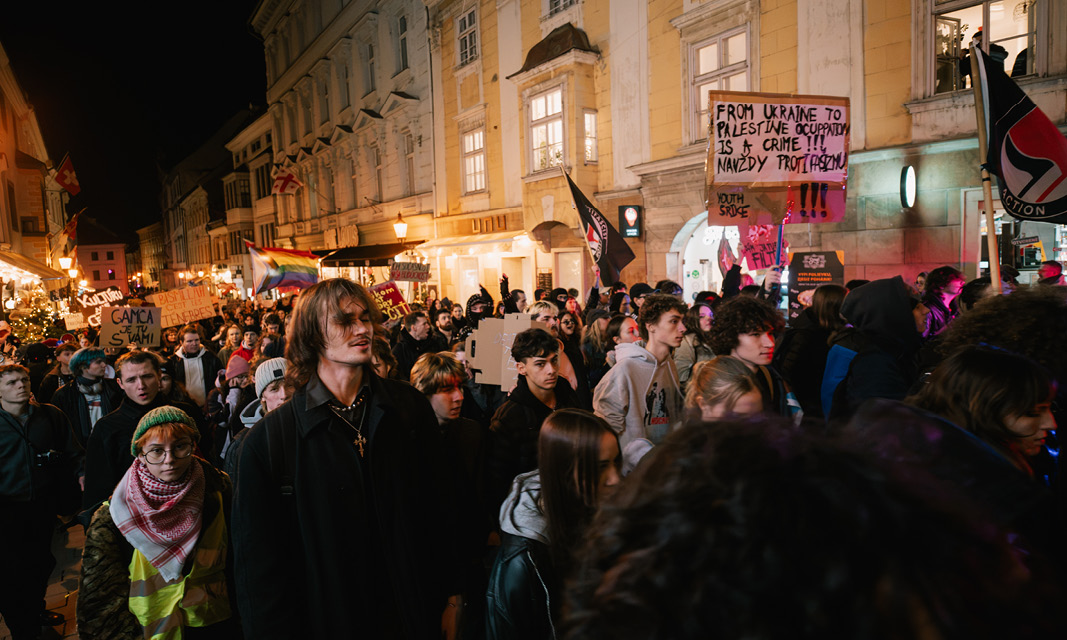
When elites talk about individual failure, are they overlooking the structure of the system? What unites and what divides young protesters—the climate crisis, migration, or class differences? And can democracy survive if economic power increasingly outweighs political power?
After years, I finally understood the truth of the horseshoe theory. Whenever the elite of a political-economic system is forced to admit its problems, they are never structural. The people are to blame.
In Katarína Lazarová’s novel Wasp’s Nest (1953), the building of socialism in the countryside constantly runs into problems: peasants have to hand over more agricultural products to the state than they are able to produce, the Communist Party uses violence against farmers, and officials and cooperative members are held to a different standard than everyone else. A bold critique of the KSČ regime at the height of the cult of personality? Perhaps quite the opposite. At the end of the novel, it turns out that the road to communism was blocked by incompetent and malicious apparatchiks who did everything in their power to sabotage the people’s democratic system. Yet even in Lazarová’s prose, the system dealt with them “justly” and, without any fundamental structural changes, continued with similar, recurring problems until it finally collapsed completely in 1989.
When there was no other way, the Communist government tolerated criticism of lower-level cadres – it even actively supported it to some extent – in order to demonstrate that it was aware of the country’s problems and was solving them. The problem was never the regime’s rigid structure or the authoritarian principles on which it stood, but always particular people or groups, or an external enemy. At one time they were “bourgeois nationalists,” at another “opportunists” and “revisionists,” and, of course, Western imperialists all along.
And look at how the right defends its system in 2026: in Ivan Mikloš’s commentary we read that the crises to which youth protest movements across Europe are responding are not “the failure of capitalism or the failure of democracy, but the failure of the elites that have governed states for a long time.” Of course, mistakes occurred in the political-economic system after 1989 that “brought us to where we are, but they were antidemocratic and anticapitalist mistakes. The mistakes did not consist in adhering to the principles and rules of democracy and capitalism, but in violating them.” It is appropriate to draw a lesson from the crisis-ridden development!
How to distinguish the young
The former finance minister deals with two alleged reasons for Generation Z’s dissatisfaction: the climate crisis and illegal migration. The International Youth Strike, however, is connected with illegal migration about as much as the protests of November 17. Not at all. Let us not be too strict, though: young people marched through Bratislava’s streets on Friday, and young people also appear in Lívia’s videos about the Save Europe Act. They must be concerned with the same thing, right? Who wouldn’t be confused when they see so many young people in one Facebook post after another? I will therefore offer a simple aid for distinguishing between them:
Migration is not mentioned even once in the manifesto of the International Youth Strike, while the climate is mentioned seven times. The climate is not mentioned even once in the Save Europe Act charter, while migration is mentioned seventeen times.
At the International Youth Strike march, people chanted the slogan “Solidarity is our weapon!” At Save Europe Act rallies, they chant “Send them back!”
Speakers at the Slovak International Youth Strike criticized the current far-right government and distanced themselves from it. The Slovak faces of the Save Europe Act shake hands with the prime minister and compete with him in extremism.
The same hill, a completely different load
Ivan Mikloš interprets the youth movement as an expression of intergenerational conflict. And although young people’s dissatisfaction does have a generational dimension, such an interpretation is misleading. The Denník N commentator magnanimously understands that they dislike various things, but at the same time suggests that they are somewhat delulu, because income and other differences between generations have allegedly been narrowing in recent years. So let us look at Slovak data: the latest statistics comparing the development of the wealth of individual generations before and after the pandemic show that the net wealth of households in the 45-to-54 age group increased by 15 % during this period, while in the 16-to-34 age group it fell by almost the same percentage (16 %). In terms of wealth, these generations therefore moved more than 30 percentage points further apart. This is how the National Bank of Slovakia comments on it:
“Many young families entered the housing market late, that is, when prices were high and interest rates were rising. They therefore started out with a heavy backpack full of debt, moreover at a time when weather conditions were deteriorating sharply.
The same hill. A completely different load.”
For now, let us set aside the global records in inequality, which are surpassed year after year and about which Oxfam regularly reports. Let us also overlook the fact that Slovakia’s wealthiest households drop out of inequality statistics, and that real-estate rentierism and the oligopoly of technology companies are continuing to rapidly widen the economic divide in society.
This is primarily not a generational but a class problem. Even among people in their fifties there are many people living in poverty. At the same time, there are people living in Slovakia who are not even thirty years old and already own several properties. What divides us, then, is not belonging to a generation but the conditions that enable some to become wealthy easily while forcing others to live from hand to mouth. If your parents give you an apartment in a regional capital, you suddenly find yourself in a completely different life situation from someone who cannot even save enough for the down payment needed for a mortgage – and it makes absolutely no difference whether you are twenty or fifty.
The same applies to everything: you may be a talented singer, a skilled hockey player, a gifted scientist or an original researcher. But if your parents cannot financially support you, no matter how hard you work, you will always be systemically disadvantaged compared with similarly hard-working peers whose success was aided by private schools, individual training, extracurricular education or simply more time that they did not have to spend working a part-time job in a baguette shop.
The injustice of capitalism lies in its very essence: its foundations are inequalities that inevitably deepen without political regulation. The result is the emergence of a capitalist “aristocracy”: a class of people who did not work for their wealth but inherited it and enjoy hereditary rights from it without having personally contributed anything to it in any way. Their only merit is that they were born lucky. It is no coincidence that Generation Z is especially sensitive to this injustice: the first capitalist nobles in the former Eastern Bloc are right here among us. While you work to pay rent so that you have somewhere to sleep, the children of the business hotshots of the 1990s – or rather the 2000s – attend tutoring to get into elite universities around the world, develop their talents with the best experts in their field and build connections with the elite.
No one claims that there are no hard workers among people from wealthy families: they too will pour their souls out at the 37th kilometer of a marathon, except that they were driven by car to the 21st kilometer. Without help from your parents and society, you run the entire course, right from the start.
Guess who will be first at the finish line. Guess who will tell you there that you did not prepare properly for the race. Guess who will set the rules.
The legitimacy of capitalism long rested on the promise of fairness: in a free society with a free market, we all have more or less equal opportunities, and whoever tries harder achieves more. Today, hardly anyone pretends that we all start from the same line. The French bourgeoisie rose up against the aristocracy at the end of the eighteenth century partly because nobles enjoyed exceptional rights and status solely thanks to their origins, while the tenacious, increasingly powerful urban class remained disadvantaged in the state despite its diligence. From their perspective, the Ancien régime had nothing substantive left to defend and had lost all practical legitimacy. What promise of the future, apart from scaremongering about totalitarianism, does contemporary capitalism offer young people whose parents are not magnates and who do not want to subordinate their entire lives to corporate work, of which there will in any case be increasingly less as artificial intelligence expands?
Gulags and so on
The Denník N commentator is convinced that “we should sort out our impressions and concepts, because shortcuts could lead us to very ugly ends.” Yet this does not prevent him from writing two sentences later: “If we reject democracy and capitalism, we reject political and economic freedom as well.” Robust, precise argumentation, if ever there was any!
So, first of all: democracy can mean almost anything – from Swiss direct-democracy referendums to North Korean people’s democracy. The International Youth Strike formulates objections to specific political mechanisms, to a certain form of democracy, not to democracy as such (if by that we vaguely mean non-authoritarian government). Few people remember this, but Aristotle defined democracy as rule by the poor, which has nothing in common with contemporary Western democracies. I consider the most serious problem with liberal democracy to be that it is unable – and, from the perspective of many of its defenders, does not even want – to defend itself against its oligarchization, that is, total submission to economic power. Liberal democracy is unable to fulfill its basic promise: to represent and advance diverse social interests within a common legal framework. More and more people are disgusted with the current system because it is evident that wealth has a disproportionately greater influence on public life than even the strongest “decent” civic mobilization. Liberal democracy responds very flexibly to the interests of the wealthiest, but when it comes to the needs of the one-in-a-million person, priorities are always elsewhere: we cannot afford to economize on arms because we face the immediate threat of war, but we can postpone effective measures against the climate crisis indefinitely. We must protect the profits of health insurers, otherwise they would not look after us poor wretches and would find a more grateful nation, but seriously ill people can manage on Donio too, right? Not all crises are equal, and not all urgencies are equal.
If you are asking what should be done, we can begin by limiting the influence of money on politics. Money has always played a role in it, but according to a great deal of data, it now outweighs everything else. The more concentrated power is, the easier it is to bribe those who hold it. That is why we need to thoroughly decentralize the political system and bring decision-making as close as possible to the civic level (understandably, not in the sense of a cheerfully direct democracy in which the simple majority would assume total control). The influence of money on politics must be limited by law as well as through thorough oversight and enforcement of this legislation. We lack clear rules for lobbying, while the law on proving the origin of assets is purely formal. Spending on political campaigns must be strictly limited and violations of the limit effectively punished; indirect forms of political support must also be regulated. At the economic level, we need to start closing the wealth and income gap again: we need to ease the taxation of labor (especially low-paid labor) and, conversely, substantially increase the taxation of wealth (above all, real estate) and investment income. In addition, we should join a global tax system that would limit the transfer of taxable income and assets to tax havens. Smaller economic differences would benefit small producers and service providers, but above all would enable more people to participate in public and political life and advance interests that big capital will not look after. I mean, for example, the protection of the climate and nature, improvements to labor legislation, or better and more accessible public services.
Second, economic freedom is an empty concept without clarification. For Ivan Mikloš, it means freedom of enterprise and the free market. For me, it is measured by the amount of free time left over after the work necessary to secure a dignified livelihood. And by something else: the possibility of deciding where, how, with whom and on what I will work. It is a zero-sum game – greater freedom for the employer means less freedom for the employee, and vice versa. Since capitalism pushes for the highest possible profit and subordinates all processes to it, it will never voluntarily make concessions in favor of greater freedom for workers. It will not shorten their working hours while maintaining their original wages, slow down the production line or install expensive air conditioning in the factory hall merely to make work a little more bearable for the assembly-line workers. Capitalism makes concessions only when political pressure forces it to, or when taking one step back enables it to take two steps forward.
The logic of capitalism is the logic of plundering both people and nature – it is defended by those who profit from it, and if it seems acceptable to others, it is despite its principles, not thanks to them. We spend eight hours at work instead of twelve thanks to concessions won by trade unions and the left, not thanks to the magnanimity of the captains of industry. Ivan Mikloš is very precise when he claims that “every serious economics textbook lists the minimization of negative externalities among the basic duties of the state in a market economy (that is, under capitalism).” Exactly: consideration for the climate, nature and social sustainability is the responsibility of the state. Private companies are somehow not expected to provide it. But fine, if neoliberals are now also in favor of environmental taxes, why not include the disintegration of society and the psychological devastation caused by digital big capital among the negative externalities, and tax it for these blessings of economic freedom as well?
We do not need growth, but fairer distribution
It does not matter how many phrases are uttered about the need to safeguard democracy: anyone who, when protecting democracy, does not speak in the same breath about the need to fight oligarchy, and therefore extreme economic inequalities, is either overlooking the structural factors of the new authoritarianism or merely putting on a show because that is what is expected in certain circles. If political power does not limit the power of the wealthiest, capitalism will become democracy’s gravedigger. Economic inequalities are deepening rapidly year after year. The wealthiest individuals and companies are seizing the state’s basic infrastructure as well as its political institutions. Billionaires hold high office or influence its decisions. A handful of people live in unimaginable luxury, while more and more people struggle to secure basic necessities. And all this in a world with so much wealth that, if it were distributed more fairly, everyone could live with dignity, and with technologies that could reduce the amount of work we need to do to a fraction of the time we currently spend. We do not need more. We need to distribute more fairly what we already have. Capitalism played a progressive role historically, but today its destructive consequences increasingly outweigh its advantages. As the development of artificial intelligence shows, there is still no force capable of stopping its suicidal greed, its compulsion to have more at any cost.
Ivan Mikloš warns us about the risks of “such simplistic and dangerous questioning of democracy and capitalism.” But greater risks today are posed by the simplistic and dangerous defense of a system that destroys every value that stands in the way of maximizing profit and private gain. Those who walked through Bratislava’s streets last Friday understand this, unlike the commentators on Facebook.

The text was produced with the support of the Rosa Luxemburg Stiftung foundation, represented in the Czech Republic. The publisher is fully responsible for the content; the views presented in the text do not necessarily represent the foundation’s position.