Doubtful victories: Who really trusts Germany’s far-right AfD?
Kapitál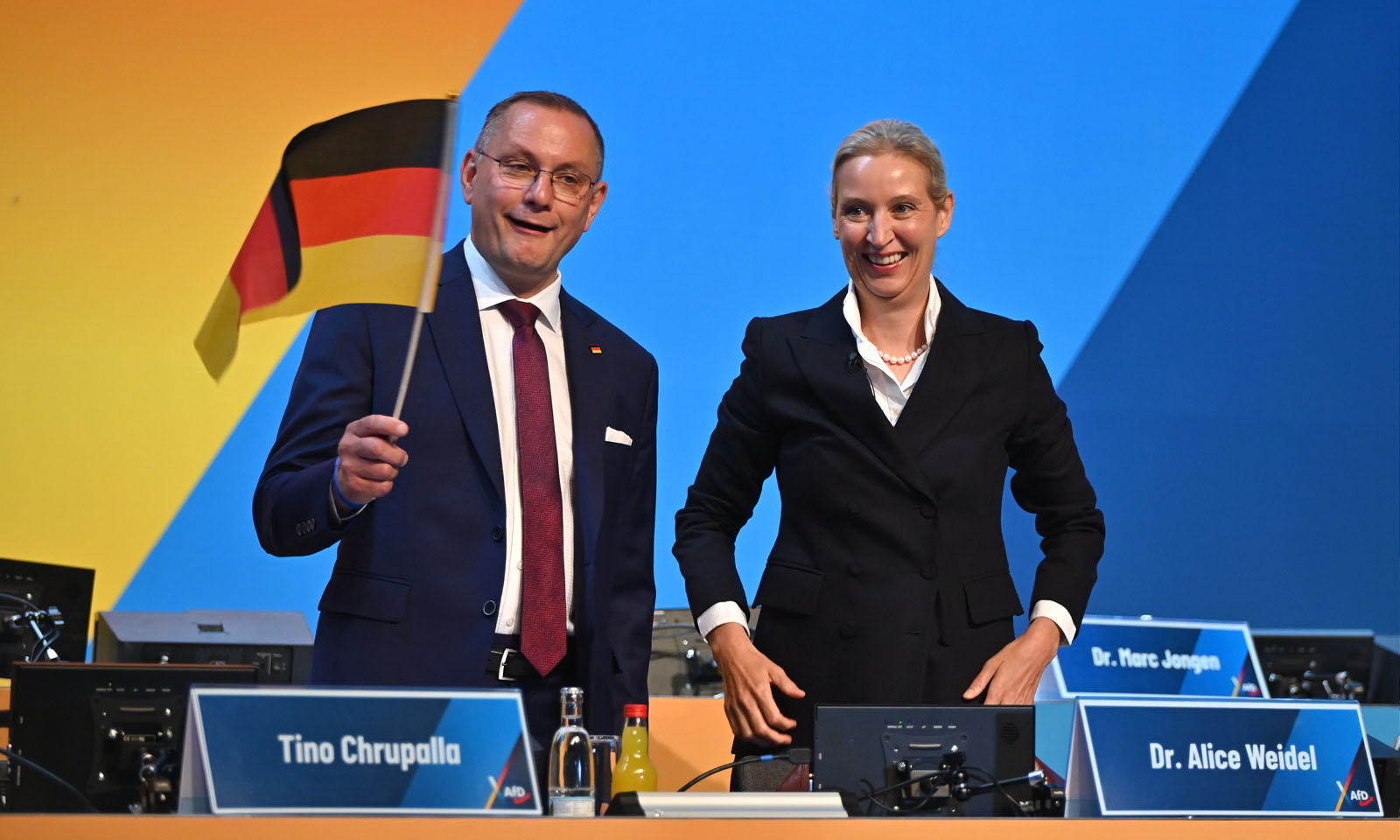
With two eastern regional elections on the horizon, Germany is once again anxious about the prospect of its first far-right state government. The Alternative for Germany (AfD) party is already declaring itself the winner, with latest record-breaking poll results fueling their optimism. But polls are not elections — a truth AfD election results have demonstrated for over a decade now.
With two eastern regional elections on the horizon, Germany is once again anxious about the prospect of its first far-right state government. The Alternative for Germany (AfD) party is already declaring itself the winner, with latest record-breaking poll results fueling their optimism. But polls are not elections — a truth AfD election results have demonstrated for over a decade now.
Russian is to become a mandatory subject in schools. Rainbow flags in front of school buildings would be replaced by the national flag; Holocaust commemoration in history lessons, by a new focus on the “success story” of the German state. At the same time, current compulsory schooling would give way to mandatory education, which could also be completed online or at home.
These are only a few of the latest and most far-reaching announcements by Germany’s far-right AfD, which is heading into the next election cycle with confidence. In September 2026, three eastern German states will elect new parliaments: Saxony-Anhalt on September 6; Mecklenburg-Vorpommern two weeks later, as well as the city-state of Berlin.
Education is one of the policy areas in which Germany’s federal states differ most. Internal security, especially policing, is another. Because state governments hold significant power in both fields, the AfD has made cultural conflict in education a central part of its campaign. At the same time, the party continues to promote its "remigration" concept, aimed at reducing migration and "Germanizing" society. In the field of internal security, they want to establish a "volunteer citizen force" alongside the regular police, challenging the state’s monopoly on the use of force.
AfD representatives appear highly confident; their regional leaders are already speaking of "the first AfD-led regional government in Germany." Instead of a traditional election strategy, the regional AfD in Saxony-Anhalt launched a "government action plan." The media is already calling it a "Machtübernahme" (takeover of power) — a deliberate reference to Adolf Hitler becoming Reich Chancellor in 1933, also through democratic elections.
40% East, 20% West
The latest polls from mid-May support their optimism: they project the AfD to become the strongest party — in Saxony-Anhalt with 42%, and in Mecklenburg-Vorpommern with 36%. These numbers seem to keep rising. A survey from mid-June shows that even at the federal level, the AfD might soon outpace all its competitors. With 29%, it leads far ahead of the Christian Democratic Union (CDU, 22%), the Social Democratic Party (SPD, 13%), the Greens (14%), and the Left (10%). The Liberals and others would fail to clear the 5% threshold required to enter parliament.
The latter poll disrupts the widespread cliché that the AfD is purely an eastern German phenomenon, driven by frustration and disappointment over the capitalist transition after the former socialist GDR was integrated into the Federal Republic of Germany (BRD).
While this historical context is not entirely wrong, the rise of the AfD differs from, for example, the temporal success of the extremist National Democratic Party of Germany (NPD) in the 2000s. In Saxony, the NPD was elected to the regional parliament in 2004 and remained there – but only there – until 2014. Founded in 2013, the AfD initially weakened the radical NPD with its back-then moderate conservative positions and focus on economics.
Only during and after the European migration challenges of 2015/16 did the AfD shift further to the right, adopting the xenophobic and Islamophobic rhetoric of anti-migration movements like Pegida in Dresden and pushing less radical politicians out of the party.
Capitalizing on Crises and Wars
This actually has become their main – and highly successful – approach to several subsequent crises. At the very beginning of the COVID-19 pandemic, AfD representatives criticized the government for not doing enough to keep society safe from the virus. However, after a few months, as the first lockdowns and chaotic, regional rules frustrated the public, the AfD recognized a growing protest movement against pandemic safety measures and vaccination. The AfD quickly pivoted to join the Corona skeptics.
Similarly, after Russia’s full-scale invasion of Ukraine in 2022, it took the German AfD several months to figure out which position would most effectively mobilize voters. They eventually aligned themselves with pro-Russian, anti-NATO movements and deepened their connections to Russia, for instance by visiting economic forums in St. Petersburg.
Regarding the wars in the Middle East, the German AfD remains largely quiet due to internal conflicts between showing support for Israel and harboring antisemitic tendencies and obvious Islamophobia among its politicians.
Nevertheless, each of these crises has helped the party achieve renewed electoral success. And yes, the AfD has always been more popular in the eastern regions of Germany − and it still is, averaging between 30 and 40 percent in recent regional and municipal elections. But it is also steadily gaining supporters in the West, breaking the 20% barrier. The AfD is already represented in 15 out of 16 German regional parliaments (with Schleswig-Holstein in the north being the sole exception).
Since March, the new regional parliament of Baden-Württemberg in the southwest consists of 56 members each from the conservative CDU and the Green Party, 35 from the AfD, and 10 from the SPD. In the western state of Rhineland-Palatinate, the CDU gained 39 seats, the SPD 32, the AfD 24, and the Greens 10. In both regions, the AfD secured around 19 percent of the vote, making them the third-strongest force.
Consequently, when Björn Höcke, the ideological leader of the AfD in Thuringia (who was actually born and raised in western Germany), recently made crude remarks on a Swiss podcast — claiming that "in the western part of the country, there are German-speaking Americans; in the eastern part, there are German-speaking Germans. In the East, people are still German" — he faced sharp criticism from the party’s federal leadership. They feared he could easily damage their recent successes in the West.
Moreover, the AfD is becoming increasingly popular among the youth in both the West and the East. Reports and experts attribute this to the same reasons seen in adults: disappointment with established political parties, feelings of being left behind — especially in rural areas — and a backlash against the dominant green and progressive values of recent years.
The pandemic, energy crises, and escalating wars have strengthened the ideological search for simple answers. These issues, alongside anxiety about the future and the potential need to sacrifice living standards, are heavily exploited in propaganda campaigns by the AfD, as well as by even more extremist parties like the Freie Sachsen (Free Saxons) or Die Heimat (Homeland, formerly the NPD).
Furthermore, anti-democratic and anti-systemic movements are actively networking within Europe, as well as with authoritarian regimes like Russia and figures close to the Trump administration in the US.
In this light, the German debate over how to prevent the AfD from governing seems outdated and too narrow as it continues to focus primarily on East-West differences. The classification of several AfD state chapters as far-right extremist by the domestic intelligence agency (the Federal Office for the Constitution), along with the massive media coverage surrounding it, may have actually brought the party more useful publicity than it did to warn of the danger to the country’s democratic system.
Loud public demands to maintain the so-called "Brandmauer" (a firewall as a political consensus not to cooperate with AfD representatives) are no longer working. The AfD has been present in regional and municipal parliaments for years. Their influence there is felt in the defunding of civil society initiatives and the implementation of harsher rules for asylum seekers and other migrants.
Furthermore, out of fear of losing votes to the AfD, other parties — particularly the conservative CDU — regularly adopt elements of the AfD’s agenda. This is essentially how Germany saw the return of border controls within the European Schengen zone, the introduction of payment cards for asylum seekers, and reduced language courses for migrants.
Self-Sabotage
Yet, the AfD's weaknesses in actual political governance should be more obvious. While their main slogan — echoing the American MAGA movement — is "Unser Land zuerst" (Our country first), they struggle to position themselves in actual crisis situations. They mobilize people through fear. When forced to make decisions or participate in the legislative process, they run out of accusations against the "established parties."
Another example is the potential return of compulsory military service. Generally, the AfD supports reintroducing the draft. However, its ranks include so many pro-Russian politicians who reject any possibility of a Russian attack on NATO states or Germany itself that the party still lacks a coherent stance on this highly urgent issue. If you say "Our country first," you must be able to defend it — a point on which the AfD remains highly ambiguous.
At the same time, at the district and municipal levels, AfD members are known for sabotaging parliamentary processes by submitting a flood of proposals that ultimately fail due to formal or procedural errors. In doing so, they seem to try to fulfill their own prophecy of a "dysfunctional democratic system."
But they are also damaging themselves. In latest local elections, the AfD lost far more mayoral elections in eastern Germany alone in 2026 (25 losses) than it managed to win (only two, in Zehdenick in Brandenburg and Altenberg in Saxony). Even in Görlitz (Saxony, on the Polish border) they lost — right in the heart of a district where the AfD is the strongest party with 36%, and whose direct candidate, Tino Chrupalla, is the co-lead-speaker of the federal party. As the leftist newspaper taz reports, in local elections, voters tend to trust experience and personal connections over the radical rhetoric of lesser-known, newer politicians.
This is where we observe that polls are not elections: Polls can alarm the population and motivate them to vote differently. While the current democratic mainstream may have to accept the parliamentary presence of the AfD as the far-right, xenophobic, and economically liberal party it indeed is, the majority of voters still do not seem to trust them with the actual responsibility of governing. We will see who the voters of Saxony-Anhalt and Mecklenburg-Vorpommern choose to trust this autumn.


Text je súčasťou projektu PERSPECTIVES - novej značky pre nezávislú, konštruktívnu a multiperspektívnu žurnalistiku. Projekt je financovaný Európskou úniou. Vyjadrené názory a postoje sú názormi a vyhláseniami autora(-ov) a nemusia nevyhnutne odrážať názory a stanoviská Európskej únie alebo Európskej výkonnej agentúry pre vzdelávanie a kultúru (EACEA). Európska únia ani EACEA za ne nepreberajú žiadnu zodpovednosť.