"Russian disinformation is effective primarily because it exploits pre-existing divisions rather than creating them from scratch"
New Eastern Europe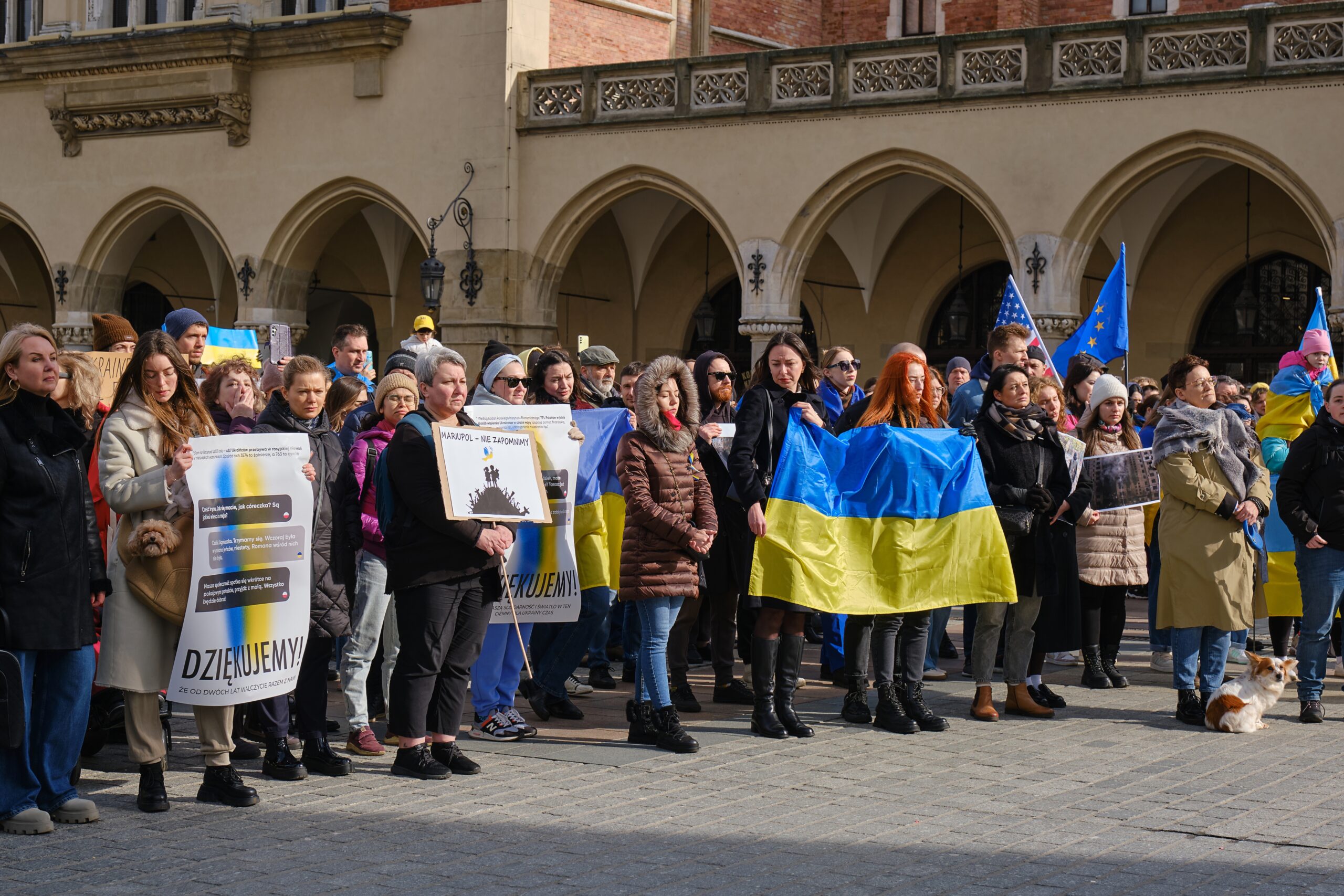
An interview with Kinga Anna Gajda, director of the Centre for European Studies at the Jagiellonian University. Interviewer: Iwona Reichardt.
IWONA REICHARDT: In your research that was aimed at examining the rhetoric towards Ukrainian refugees in Poland you observed a change in attitude towards Ukrainians among Polish social media users. What are the factors behind this change?
KINGA ANNA GAJDA: The change in Polish attitudes towards Ukrainians cannot be attributed to a single factor. Rather, it is the result of an interplay of social, economic, political, psychological, and historical processes. In the immediate aftermath of Russia’s full-scale invasion of Ukraine in February 2022, solidarity and an unprecedented level of civic mobilization dominated public responses in Poland. Society, public institutions, and non-governmental organizations engaged extensively in providing humanitarian assistance and support for refugees. Over time, however, new challenges emerged, including concerns regarding the financial costs of assistance, pressure on public services, competition in the labour market, and questions about the long-term integration of Ukrainian refugees into Polish society.
An additional factor influencing the evolution of public attitudes is the phenomenon commonly described in academic literature as “crisis fatigue” or “compassion fatigue”. For several years, the Polish society has lived in the immediate vicinity of an armed conflict that remains highly visible in political discourse and media coverage. Prolonged exposure to reports of violence, insecurity, and human suffering can lead to emotional exhaustion and a gradual decline in public engagement. This mechanism has been widely documented in psychological and sociological research on societies experiencing long-term humanitarian crises.
The most significant and enduring factor shaping attitudes towards Ukrainians, however, is the historical dimension. In Poland, collective memory plays a central role in the construction of national identity, and historical experiences frequently influence political rhetoric and social perceptions. Thus, historical issues should be regarded as one of the most important explanatory factors in understanding current attitudes. Particularly significant are the unresolved disputes concerning Polish-Ukrainian relations during the Second World War, especially the massacres of Polish civilians in Volhynia and Eastern Galicia carried out by the Ukrainian Insurgent Army (UPA). The memory of these events remains deeply embedded in the Polish collective consciousness and continues to influence public discourse, political debates, and moral evaluations of contemporary Polish-Ukrainian relations. Thus it is the divergent interpretations of the past what has been generating tensions between Poland and Ukraine.
We have seen that play out recently…
Yes, the controversies have intensified following decisions by the Ukrainian authorities that reference the legacy of the UPA, including President Volodymyr Zelenskyy’s decision to grant one military unit the honorary title “Heroes of the UPA”. In Poland, this decision was widely criticized and interpreted by many as an act of legitimizing or commemorating an organization associated with crimes against the Polish civilian population. On June 19th, Poland’s president, Karol Nawrocki, stripped Zelenskyy of Poland’s highest honour – The Medal of the White Eagle. There is no doubt that such developments reinforce existing divisions and complicate efforts aimed at historical reconciliation.
On top of that, social media platforms are playing a substantial role in amplifying historical controversies. Their algorithms prioritize emotionally charged content, including narratives based on outrage, resentment, and perceptions of threat. As a result, contentious interpretations of history receive greater visibility than messages emphasizing cooperation, dialogue, and reconciliation.
To what extent is this online hostility reflective of broader social attitudes?
Internet hate speech should not be interpreted as a direct reflection of the attitudes of society as a whole. The architecture of social media platforms tends to amplify controversial, emotionally charged, and polarizing content because such material generates higher levels of user engagement. As a result, relatively small but highly active groups can appear disproportionately influential in online discussions, creating a distorted perception of broader public opinion. At the same time, it would be inaccurate to dismiss online hostility as merely a product of digital algorithms. Online discourse often reveals genuine social tensions and divisions that exist within society. Public opinion surveys indicate that Polish attitudes toward Ukraine and Ukrainian refugees are considerably more nuanced than the polarized narratives commonly observed on social media.
There has also been research showing that different entities that spread Russian disinformation in Poland exploit existing tensions in Polish society. In your view, why have certain anti-Ukrainian narratives proven so effective, and what makes Polish society particularly vulnerable – or resilient – to such influence operations?
Russian disinformation is effective primarily because it exploits pre-existing divisions rather than creating them from scratch. Research on information influence operations demonstrates that disinformation campaigns are most successful when they use existing grievances, emotional sensitivities, and unresolved societal conflicts. In the context of Polish–Ukrainian relations, historical issues constitute especially fertile ground for manipulation. Contemporary scholarship on cognitive warfare suggests that Russian disinformation narratives are highly adaptive and evolve in response to changing political circumstances and public attitudes. One of the most common techniques involves the reversal of the roles of aggressor and victim, whereby Russia portrays itself as a defensive actor responding to external threats. Such narratives seek to undermine international support for Ukraine, weaken confidence in Western institutions, and legitimize Russian military and political actions. Russian operations directed against Ukraine and western democracies illustrate that the objective of such campaigns is not merely to persuade audiences of specific political positions, but rather to erode social cohesion, diminish trust in public institutions, and deepen cleavages.
The instrumentalization of historical memory is particularly significant in the Polish–Ukrainian context. Analyses conducted by the Mieroszewski Centre and the Stefan Batory Foundation suggest that contemporary Ukrainian interpretations of the UPA are closely linked to processes of nation-building, decolonization, and resistance to Russian imperial domination. For many Ukrainians, UPA symbolism is associated primarily with the struggle for national independence and opposition to Soviet and Russian rule rather than with the events of Volhynia. In Poland, however, the collective memory of the UPA remains strongly connected to the mass killings of Polish civilians during the Second World War. These divergent historical narratives create a significant memory asymmetry. Russian operations it by portraying Poles and Ukrainians as nations divided by irreconcilable historical grievances.
At the same time, Poland demonstrates a relatively high degree of resilience to Russian influence operations compared with many other European countries. This resilience is rooted in several mutually reinforcing factors, including a robust civil society, a pluralistic media environment, active fact-checking organizations, and widespread public awareness of the threat posed by Russian influence activities. Historical experiences of Soviet domination have also contributed to a heightened sensitivity towards Russian propaganda and information manipulation. As a result, overtly pro-Russian narratives generally achieve limited public acceptance within Polish society.
Thus, the effectiveness of Russian disinformation in Poland should not be understood as its ability to fundamentally transform public opinion. Rather, its primary impact lies in amplifying existing divisions, increasing mutual distrust, and complicating efforts to achieve social and political consensus on issues such as security, migration, and historical memory
Which specific educational or social initiatives do you believe have the greatest potential to reduce hostility and polarization in Poland?
The greatest potential for mitigating social tensions and strengthening cohesion lies in educational initiatives and projects based on direct interpersonal contact. Research in social psychology shows that prejudice is reduced in contexts where members of different ethnic, national, or cultural groups cooperate within shared, long-term activities. Cooperative forms of contact contribute to lowering social distance, reducing stereotyping, and fostering more complex and nuanced perceptions of the “other” group.
In my view, several key areas of intervention are particularly important. These include media literacy education and systematic efforts to counter disinformation, the development of intercultural competencies, and the promotion of communication based on non-violent communication (NVC) principles. Equally important is the support of joint projects involving Polish and Ukrainian youth, which can foster long-term interpersonal bonds and reduce intergroup distance. Integration programmes at the level of higher education institutions also play a significant role, as do targeted training initiatives for key professional groups such as teachers, journalists, and public administration officials. A particularly critical component of these efforts is education on the mechanisms of disinformation, fake news, and Russian information operations, which remain among the primary drivers of social polarisation and the destabilisation of the information environment.
Looking ahead, what do you think Polish-Ukrainian relations will look like once the war ends? Do you expect mutual understanding to deepen, or could the end of the war bring new tensions and challenges for both societies?
Polish–Ukrainian relations after the end of the war are likely to become more pragmatic than emotional. The period of exceptional mobilisation and unconditional solidarity in 2022 was rooted in an extraordinary security crisis and, as analyses of contemporary geopolitical dynamics suggest, does not constitute a stable long-term model of interstate relations. The end of the war, however, does not necessarily imply a deterioration in bilateral relations; rather, it is more likely to mark a transition towards a more complex and multi-layered form of “partnership despite differences”.
On the one hand, there are strong structural foundations for continued integration and deepening cooperation. Central Europe, including Poland and Ukraine, is increasingly emerging as a key actor in the evolving European security architecture. The shared experience of Russian aggression, combined with a similar understanding of Russia’s imperialism, provides a durable basis for strategic alignment.
On the other hand, the end of the war may also expose or intensify existing tensions, particularly in the historical and symbolic dimension. Memory-related issues are likely to remain among the most sensitive aspects of bilateral relations. Experience from recent years demonstrates that history is readily instrumentalised in public discourse, including in domestic political competition and electoral cycles. In a post-war context, when the unifying external threat diminishes, such disputes may regain salience and acquire greater political significance.
A further challenge concerns social integration. Empirical studies of public attitudes indicates that despite support for Ukraine in Poland, the Polish society expresses concerns in regards to such issues as migration, labour market pressures, and the long-term presence of Ukrainian refugees. This suggests that intersocietal relations may enter a new phase.
Kinga Anna Gajda is the director of the Institute of European Studies of the Jagiellonian University in Kraków.
Iwona Reichardt is the deputy editor in chief of New Eastern Europe and a member of the management board of the Jan Nowak-Jeziorański College of Eastern Europe in Wrocław.